
Meadow & Woodland
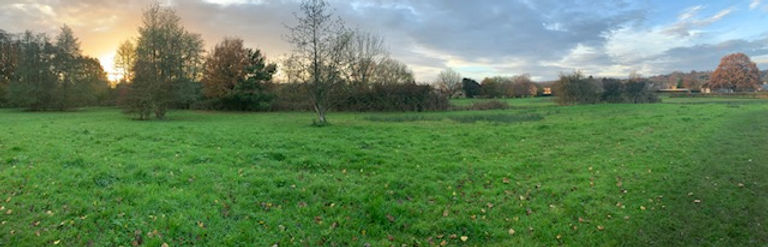
The story of the grassland at the Alderbed Meadow is one of survival against the odds. It's like an ancient building surrounded by modern tower blocks - a little piece of history that has ridden out great changes. At one time, wet grasslands like this would have been common along the foot of the North Downs. After World War Two, farmers were encouraged to 'improve' their land to maximise yields. Most wet grasslands were drained and either ploughed up or fertilised, with the loss of their special wildlife.
So how did the grassland here survive this process?
The answer is, somewhat by accident. The Alderbed Meadow was originally part of Palace Farm. After the development of nearby housing and the creation of the playing field in the 1960s, the Alderbed Meadow became isolated from the rest of the farm. It fell into dis-use and remained so for decades, until it was donated to the Charing Playing Fields Committee in 1999.
The Grassland
The grassland is now being managed in the traditional way by grazing. You may be wondering, if this grassland did so well with no human interference for so long, why it now needs to be managed. The Cattle - four-legged conservationists reason is that there is a very powerful force of nature acting on it. It is called 'succession'. Woodland is the natural state for most of our landscape, and nature is constantly trying to push it in that direction, through the process of succession. Left unmanaged, the grass land here would be colonised by trees, become scrubby, and eventually that scrub would turn into woodland.
Another reason to graze is to increase the diversity of the grassland. Grazing stops the more vigorous species from dominating, and makes room for a greater variety of plants. And it's not just plants that this special grassland supports - as you will see in later sections of this booklet, it is also home to water shrews and other small mammals, grass snakes, and a wide variety of insects.
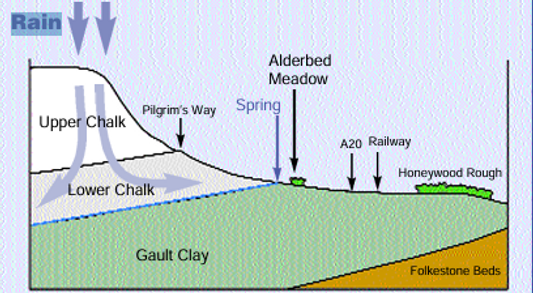
There are many features of the Alderbed Meadow that make it special, but perhaps most important of all are the chalk streams that flow through it. Ex-stream-ly important! They start from a spring at the foot of the downs (see diagram).
These little streams may look small and insignificant, but they influence everything here. Without them, the grassland would look completely different - the rushes, sedges and wet-loving plants like ragged robin and meadowsweet would not survive. The wet woodland here is very special, because of its alder carr and the flora and fauna that thrive in its boggy areas, all of which is due to the water brought in by the streams. Water shrews, grass snakes and whole groups of insects such as the many craneflies recorded, would all disap pear without the clear, un-polluted waters.
Regardless of how they affect the land around them, the streams are superb habitats in their own right. They are 'head waters' - streams forming the source of a larger waterway. After their journey through the Alderbed Meadow, they flow into the Charing Stream, which in turn joins the Great Stour. Headwaters have their own unique wildlife, but on a very small scale: tiny freshwater shrimps, pea mussels and leeches, the larvae of caddis flies and other insects, all thrive in these trickling waters. Surveys revealed that the headwaters at the Alderbed Meadow are particularly diverse, indicating a high water quality and a pristine habitat. Just as important as the water quality is the variation in the character of the streams - wide in places, narrow in others; slow flowing sections with a silty stream bed, and faster sections over gravel. In places the water flows over tufa- an unusual rock formed as a limestone deposit in chalk streams. Seasonal changes are also important: low flow in summer creates damp margins important for many insects; in winter, the main streams flood, supporting the fen vegetation of the wettest areas. These characteristics show that the streams are very natural, forming a wetland ecosystem little altered by man, and the streams are being protected to ensure that they remain so.
Where do the streams come from?
This cross section shows how rain water drains through the chalk of the North Downs and when it meets underlying clay seeps out of the ground as springs
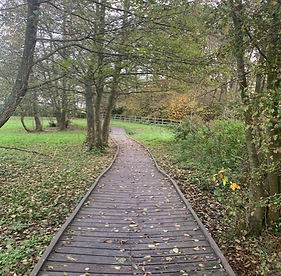
The Woodland
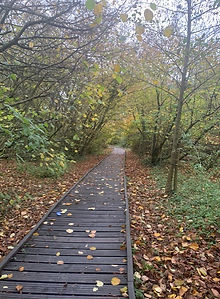
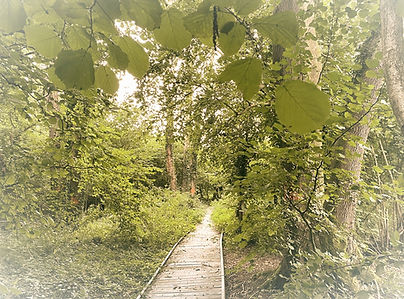
The woodland at the Alderbed Meadow may be small, but it is a fantastic place for wildlife. That's because it is a very 'diverse' habitat - it has lots of different places for wildlife to live. Imagine two villages. One village is made up of only one type of house, while the other has a variety of dwellings - terraced houses, large executive homes, sheltered housing for old people, and so on. The village with all the different housing types will have a much more varied population, and it’s the same with a wildlife habitat the more variety there is, the greater the number of different species that can live there.
The woodland at the Alderbed Meadow is very varied. Parts of it are dense and dark, while others are open and sunny. There are centuries-old oaks, tiny young saplings and every age of tree in between. It has boggy areas with many alder trees and drier areas dominated by ash. There are living trees, dying trees, and dead trees still standing. There's a lot going on in a small space, and the woodland can look wild and quite chaotic - but that's a good thing: a tidy woodland may be more appealing to the human eye, but is less appealing to wildlife.
One reason this woodland is so diverse is that it has been here a long time. We cannot be sure, but it is probably an 'ancient' woodland, which means it is at least 400 years old, and may be much older. A number of plants growing here, such as wood anemone, are classed as 'ancient woodland indicators' and may be a clue to its great age.
Ancient woodlands are a living link to the primeval forest that once covered Britain, known as the 'wild wood'. Despite this wild ancestry, ancient woodlands also have a history of man agement by humans that has been going on for so long that many woodland species have adapted to it. At the heart of this management is coppicing - the ancient practice of cutting down small areas of woodland and allow ing the trees to re-grow as many thin stems.
As you walk around the woodland you will see that most of it has been coppiced in the past, and that this traditional method has now been brought back, creating open, sunny patches which are vital for many plants and butterflies. As small patches are coppiced over the years, areas with varying tree height and density are created - this is just one way that the Alderbed Meadow is being managed to create homes for wildlife