
Wildlife
For such a small site, the Alderbed Meadow boasts a surprising number of birds - some 30 different species have been recorded here! The reason for this is the rich variety of the site's habitats, providing for the needs of many different feathered residents and visitors. The basic needs of birds are much the same as ours - food, water, and some where safe to live and raise a family. For those species breeding at the Aldberbed Meadow, the diverse habitats have got something for everyone.
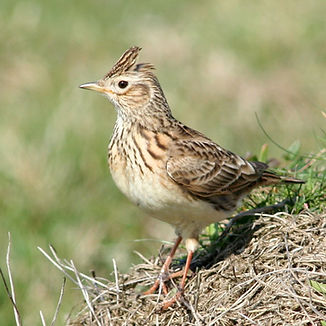
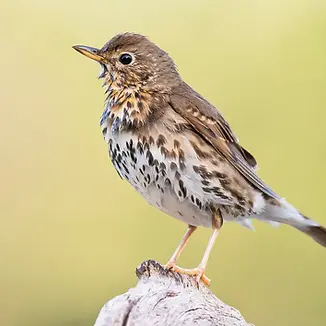
Because the woodland has large, old trees, wood peckers, tits and stock doves can find nesting holes. The hedges bordering the grassland provide ideal nesting sites for the linnet, a species that has declined across Britain in recent years, as well as commoner species such as wren and blackbird. Skylarks, also in decline, have been recorded here and may be breeding in shorter areas of the grassland. Another bird that has become a priority for conservation is the song thrush - it breeds in the woodland at the Alderbed Meadow. Its delightful song can be distinguished from others by its repetition of every phrase.
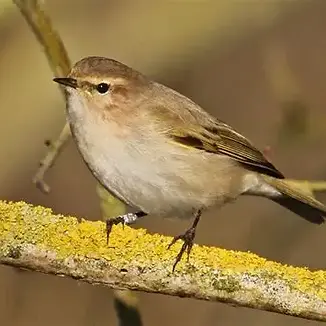
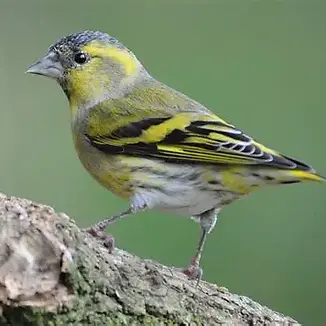
Like some human communities, the bird community at the Alderbed Meadow has Siskin both its year-round residents and its summer visitors. Chiffchaffs and whitethroats arrive from north Africa in the spring to nest along side our more familiar chaffinches and coal tits. The chiffchaff gets its name from its cheerful 'chiff-chaff' song which can be heard in woodlands as early as March.
Sky Lark
Song Thrush
.webp)
ChiffChaff
.webp)
Siskin
Whitethroats sing their scratchy warble from hedges and can be seen flitting along the tops of hedgerows. While the Alderbed Meadow is a home for many birds, others regard it more as a restaurant. Again, the site's diversity provides for many different tastes. The wet woodland with its alder provides food for the siskin, which feeds on this tree's tiny seed cones.
The site is notable for the variety of flies recorded here, which include some scarce species. To swifts and house martins they are breakfast, lunch and dinner - we don't know if the rare ones taste any better! With a taste for somewhat larger prey, kestrels and tawny owls hunt over the grassland; they too have plenty of choice, as the site is home to eight species of small mammal. Once you start to think about feeding relationships like these, you realise how important it is to consider the full range of plants and animals when managing a site like this- all species are part of food chains and food webs, and actions affecting one can have an effect on many others.
If you hear a scurrying in the undergrowth next time you are walking at the Alderbed Meadow, don't be surprised - its modest six acres are home to an amazing eight species of small mammal!
These include three mice, two voles, and all three British species of shrew. Ashrew's lifestyle is all about living fast and dying young. It is a frantic little ball of energy, active both day and night, hunting for prey and aggressively defending its territory. This is down to the fastest of metabolisms: the tiny pygmy shrew, Britain's smallest mammal, has to eat its own body weight in food every day just to stay alive!
Shrews are insectivores, so typical prey are beetles, spiders and woodlice. The water shrew specialises as an aquatic predator - it loves the fresh water shrimps and insect larvae in the chalk streams here and will also take small fish and amphibians. As well as being fierce predators, shrews will fight for their patch of habitat. If you hear a shrill squeaking as you walk through the grass land, it's probably a shrew neighbour dis pute kicking off - best not get involved! The stress of these hunting hooligans' hectic lifestyle eventually takes its toll few shrews live beyond 18 months.
Not that the Alderbed Meadow's rodent residents live to be very ‘long in the tooth’ either. If a bank vole or field vole lives to be two, it probably deserves a telegram from the Queen! But in other ways, voles' lifestyles are rather different from those of shrews. For a start they are primarily veg etarian; the field vole (Britain's most numerous mammal) feeds on grasses and, to the annoyance of foresters, young tree bark.
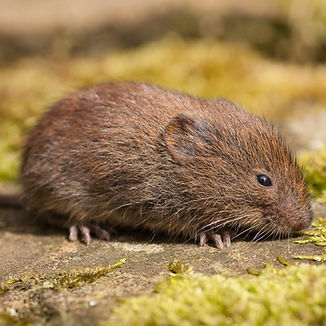
Vole
Voles are also more sociable If there’s a bustle in your hedgerow... than shrews, although they will defend their breeding territories. Britain's smallest and largest mouse species both live at the Alderbed Meadow. The tiny harvest mouse, which finds a habitat in the tall grass and herbs of the grassland, on average weighs about the same as a 2p coin (7g). The yellow-necked mouse is somewhat hefti er, the largest weighing in at six times that! It is very much a species of wood land, particularly 'ancient' sites. Their specific habitat preferences mean that the Alderbed Meadow's rodent David and Goliath perhaps rarely come face to face.
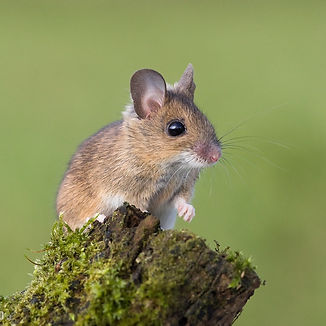
The wood mouse, in contrast, is much less fussy about where it lives. It is found in woods, but also in a wide range of other habitats. One thing that makes it so adaptable is the way it feeds. It is an 'opportunist', eating pretty much whatever is available in each season - seedlings and buds in spring, centipedes and insect larvae in summer, fruits and fungi in autumn and tree seeds in winter. It should be obvious by now that these small residents of the Alderbed Meadow have different approaches to making a living here - that's why so many different species can co-exist. But that is only possible because this small site contains such diverse habitats.
.jpg)
Wood Mouse
Most people don't spend a great deal of time thinking about flies. We usually only notice them when they become an annoyance in summer. But there are people who study this group of insects, and with nearly 3000 British fly species, many of which we know little about, there is a lot to learn. If you were a fly enthusiast, you could do worse than pay a visit to the Alderbed Meadow - it's fly central! You would probably get particularly excited about its crane-flies (known to most people as 'daddy-long legs'), of which 43 different species have been recorded.
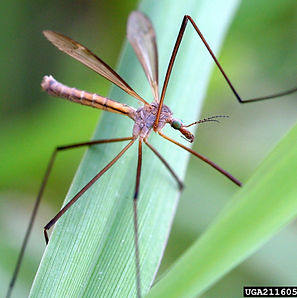
It probably comes as a surprise to you that there are so many different types of crane-fly. In fact there are about 320 species in Britain, but 43 is a very respectable total for such a small site! Two of these species are described as 'nationally notable', but little is known about what they feed on, their breeding habits or behaviour.
crane flies (Genus Tipula)
One species found at the Alderbed Meadow was last recorded in Kent in 1965! Where something is known of how flies live, there are often some surprises in store. The flesh fly Amobia signata is what is known as a 'cleptoparasite'. It lays its eggs in the nests of solitary bees and wasps. When the larvae hatch, they eat the food provided by the adult bee or wasp for its own larvae. One of the family known as picture-winged flies (so called because of the translucent patterns on their wings) has a larvae that develops inside a hard gall, that is only found in the seed heads of the plant fleabane. The larvae of Dixa submaculata are aquatic - they attach themselves to stones in streams and feed on passing particles and organisms.
With such a wide variety of feeding and breeding habits, it's not hard to see that if we want to conserve these scarce insects, the Alderbed Meadow must not lose any of its natural diversity.
And this diversity also provides habitats for a variety of other insects: beetles (including one species thought to be extinct in Kent), grasshoppers, crickets (such as the uncommon Roesel's bush cricket), dragonflies, bees and butterflies (including the beautiful small copper). So next time you're enjoying the wild flowers and birds at the Alderbed Meadow, don't forget the insect wildlife there is just as important. And please don't swat any flies!