

Plants of the Meadow & Woods
If the plants at the Alderbed Meadow could talk, what a story they would tell! - the story of their survival, as all around the landscape has changed so much. But in a way they do tell us that story, just by growing here together. Plants that grow in valuable habitats are not just random collections of species - they are 'communities' of associated plants that are found together time and time again, and can tell us a lot about the origins of that habitat. Woodland plants in particular speak volumes about history, as you may have read in the section on woodland habitats.
The rich grassland plant communities at the Alderbed Meadow also tell us a lot they don't just appear overnight, and suggest that the grassland is also old. The individual plants also have some fascinating folklore associated with them. This section tells you about the traditional uses and names for some of the plants at the Alderbed Meadow.

Ramsons or wild garlic
This plant loves damp woods, and carpets the woodland at the Alderbed Meadow in spring. Just as impressive as the show of white flowers at this time is the unmistakable reek of garlic. It's no wonder that traditional names for this plant include stinking nanny, stink bombs and stink onions. Despite these off-putting names, ramsons leaves have long been used to supplement the diet of country people when times were hard, added to salads, stews and soups.
This plant is an indicator of ancient woodland.

Wood anemone
One of the ancient wood land indicator plants, wood anemone tells us perhaps more than any other plant that the woodland at the Alderbed Meadow is very old. In Kent it rarely grows outside ancient woodlands, and spreads very slowly - an estimated six feet per century! Wood anemone is also known as 'windflower'. It's more obscure traditional names include 'Grandmother's nightcap', and in parts of Derbyshire it is known as 'moggie night gown' (this doesn't refer to miniature cats- in that part of a world a 'moggie' is a mouse!).
Common Hogweed (Heracleum sphondylium)


Fools Watercress
Fool’s Watercress typically reaches heights of 40 centimeters (approximately 16 inches) with erect, hollow stems that can also root in submerged soils. The leaves are divided into broad, lanceolate leaflets which can measure up to 6 cm (about 2.5 inches) long. These leaves contribute to its lush appearance and are a key habitat provider for wildlife.
This versatile plant plays a crucial role in its ecosystem. Fool’s Watercress provides habitat and food for various aquatic creatures, including insects, amphibians, and small mammals. Additionally, its extensive root systems help stabilize riverbanks and prevent soil erosion. As a production zone for organic matter, Fool’s Watercress contributes to the nutrient cycle in wetland environments.
Meadowsweet
The English common name meadowsweet dates from the 16th century. It did not originally mean 'sweet plant of the meadow', but a plant used for sweetening or flavouring mead. An earlier common name dating from the 15th century was 'meadsweet'.
Meadowsweet is known by many other names. In Chaucer's The Knight's Tale it is known as meadwort and was one of the ingredients in a drink called "save". It was also known as bridewort, because it was strewn in churches for festivals and weddings, and often made into bridal garlands. In Europe, it took its name "queen of the meadow" for the way it can dominate a low-lying, damp meadow.


Doc Curl
The plant produces an inflorescence or flower stalk that grows to 1.5 metres (5 feet) It has smooth leaves shooting off from a large basal rosette, with distinctive waved or curled edges; these can grow to 14–24 centimetres. On the stalk, flowers and seeds are produced in clusters on branched stems, with the largest cluster being found at the apex.
Willow Herb
The Onagraceae are a family of flowering plants known as the willowherb family or evening primrose family. They include about 650 species of herbs and shrubs, The family is widespread, occurring on every continent.
The family includes a number of popular garden plants, including evening primroses (Oenothera) and fuchsias (Fuchsia). Some, particularly the willowherbs (Epilobium), are common weeds in gardens and rapidly colonize disturbed habitats in the wild


Speedwell
Considered a good luck charm for travellers, the bright blue flowers of speedwell are meant to 'speed' you on your way. This reputation may well have come about because of its habit of forming large clumps in hedgerows, roadside verges and grassy lanes; it can also be found on grasslands and in open woodlands. The flowers appear from April to June
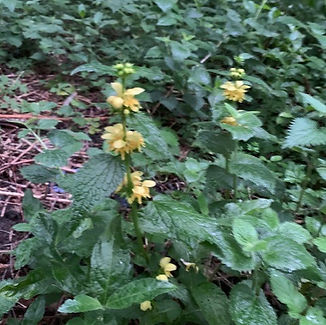
Yellow Archangel
Lamium galeobdolon, the yellow archangel, is a species of flowering plant in the mint family. It is native to Europe and western Asia but it is widely introduced in North America and elsewhere. It is the only species in the genus Lamium with yellow flowers. Another common name for this species is golden dead-nettle. The common names archangel and dead-nettle have been in use for hundreds of years, dating back to at least the 16th century.

Sedge
Sedges are often mistaken for grasses due to their narrow, strap-like leaves.
Sedges are highly adaptable and can grow in a variety of environments: Moist or wet areas such as Streams, ponds, bogs, and wetlands. Shade tolerance: Many sedges thrive in partial to full shade, unlike most grasses that prefer sunny, well-drained soils.
Soil adaptability: They can tolerate both moist and dry soils, depending on the species.


Woody Nightshade
Despite being a member of the nightshade family, Bittersweet (also known as 'Woody Nightshade') is one of the less toxic plants in this group, althought its berries are still poisonous. Found in hedgerows, gardens and even on shingle beaches, its purple flowers appear from May to September, and are followed by clusters of bright red berries.